
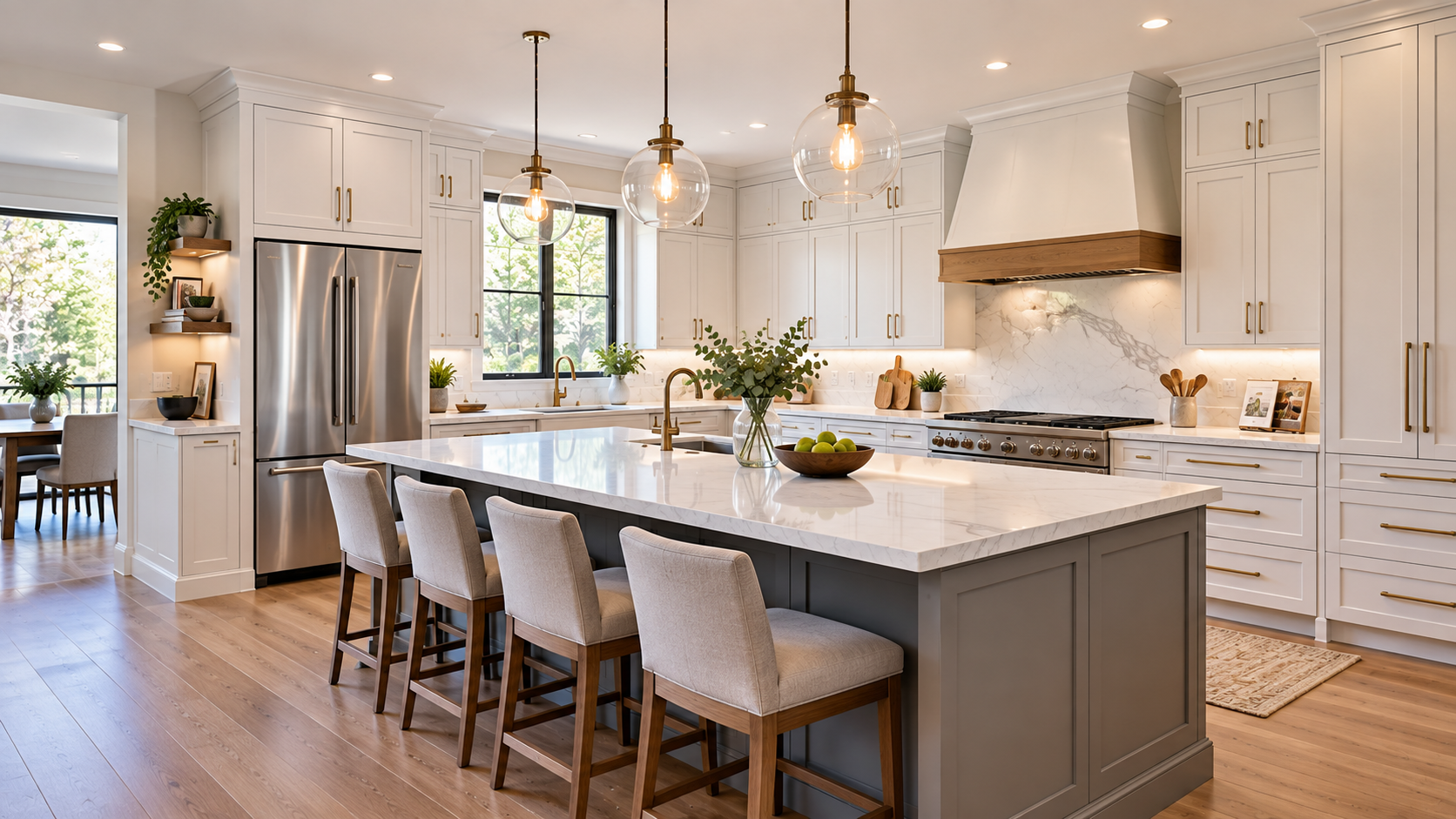
Cabinets take up more of a kitchen’s budget than almost anything else, and the first real decision is whether to buy them off the shelf or have them built. For homeowners in Chico and across Butte County, the choice between custom cabinets vs stock cabinets shapes how much you spend, how long you wait, how much storage you end up with, and how the kitchen holds up ten years from now.
Most homeowners start by comparing prices, which makes sense, but price only tells part of the story. A cheaper cabinet that doesn’t fit the room can cost you storage space and leave gaps along every wall. A custom cabinet that’s built well will usually outlast stock cabinets. Knowing what you’re actually paying for makes the decision much easier.
Before you start pricing out cabinet lines or measuring your walls, it helps to understand how each type is made. If you’re still working out how big the project is, our guide to kitchen remodel vs. kitchen renovation covers that first. If you’d rather talk through your own kitchen, you can reach out to our team directly.
What Are Stock Cabinets?
Stock cabinets are mass-produced in standard sizes and kept in inventory at home centers and distributors. Widths usually come in 3-inch steps, commonly between 9 and 48 inches. Base cabinets are typically 34.5 inches tall and 24 inches deep, and wall cabinets are about 12 inches deep. Door styles and finishes are limited to whatever the manufacturer offers that year.
Because a factory builds thousands of identical boxes, the price per cabinet stays low. Many stock lines use particleboard or MDF for the box, with thinner backs and shelves than you’d find in custom work.
A typical stock cabinet line offers:
- Fixed widths, heights, and depths
- A short list of door styles and finishes
- Particleboard or MDF cabinet boxes
- Basic hinges and drawer slides
- Availability from inventory or within a couple of weeks
For a rental, a quick update before selling, or a laundry room, stock cabinets can be a smart buy. The trade-off shows up at installation. Walls rarely measure out in neat 3-inch steps, so installers close the gaps with filler strips, and a couple of inches at each end of a run adds up to storage you can’t use.
What Are Custom Cabinets?
Custom cabinets are designed and built for one specific room. The cabinetmaker measures the space, draws the layout, and builds each box to fit, whether that’s a 31-inch base next to the range or a pantry that runs to a 10-foot ceiling.
A typical custom cabinet project includes:
- Cabinets sized to your exact wall and ceiling measurements
- Your choice of wood species, door profile, and finish
- Hardwood plywood boxes with solid wood face frames or frameless European-style construction
- Full-extension drawer slides and soft-close hardware
- Interior features like pull-out trash, drawer dividers, or spice pull-outs
Construction quality varies from shop to shop, so ask any cabinetmaker what goes into the box itself, not only the doors.
Semi-custom cabinets sit between the two. The manufacturer starts with standard boxes but lets you adjust width, depth, or finish within set limits. They cost more than stock and less than custom, and they still rely on fillers in tricky spots.
The Real Difference Between Custom Cabinets vs Stock Cabinets
The core difference is fit. Stock cabinets are built first and then fitted into your kitchen. Custom cabinets are designed around your kitchen and then built. Both can look good on day one, but custom cabinets use the full wall, handle irregular spaces, and are usually built from sturdier materials.
That difference affects nearly everything else about the project, including cost, lead time, and how long the cabinets last.
Cost Comparison: Stock vs. Custom
Stock cabinets are the lower-cost option up front. You’re paying for a standard product made in volume, and you can often take it home the same week.
Custom cabinets cost more because each piece is designed and built for your room. A few factors narrow the gap, though. Custom cabinets use every inch of the wall, so you may need fewer boxes to get the same storage. Plywood boxes and solid drawers also tend to outlast particleboard, which matters if you plan to stay in the house.
The wood species, finish, number of cabinets, and complexity of the layout all push the price up or down, so a quote based on your actual kitchen is the only reliable way to know what custom cabinets will cost you.
Not sure what custom cabinets would run for your kitchen?
Get a free, no-obligation quote based on your actual space, not a national average.
Request Your Free Quote →
Timeline: How Long Does Each Take?
Stock cabinets win on speed. Many lines are sitting in a warehouse or ship within a couple of weeks, so the timeline depends mostly on your installer’s schedule.
Custom cabinets take longer because every piece is made to order. Plan on several weeks from final design approval to installation, depending on the size of the job and the shop’s workload. At Oak Ridge, our process runs through four stages: an on-site measure, a design packet with 2D diagrams and 3D renderings, production in our own shop, and installation by our own crew. If you’re working around a move-in date or a contractor’s schedule, ask for a production timeline before you sign.
Common Mistakes When Choosing Cabinets
Homeowners run into trouble most often when they pick cabinets on price alone. A few patterns come up again and again:
Buying stock cabinets for an irregular room. Older Chico homes often have walls that aren’t square and floors that slope. Stock cabinets assume a square room, so installers shim and add fillers, and the finished kitchen can still look slightly off.
Judging quality by the doors. A nice door on a particleboard box will still sag or swell if water gets under the sink. Ask what the box, back, and drawers are made of. This matters even more under stone, since a quartz or granite countertop adds a lot of weight to every cabinet it sits on.
Ordering before the layout is final. Changing a cabinet run after an order is placed can mean restocking fees on stock cabinets or redesign time on custom ones. Settle the layout first.
Getting the scope and measurements confirmed before ordering, ideally with input from our design team, avoids most of these problems.
Signs Stock Cabinets Are the Right Fit
- Your kitchen has a simple, square layout
- You’re updating a rental or getting a house ready to sell
- You need cabinets installed within a few weeks
- The budget has no room to stretch
Signs You Need Custom Cabinets
- Your home has uneven walls, tall ceilings, or an unusual floor plan
- You plan to stay in the house for many years
- You want specific storage features or a particular wood and finish
- You’re rebuilding in Paradise, Magalia, or elsewhere in Butte County and designing the kitchen from scratch
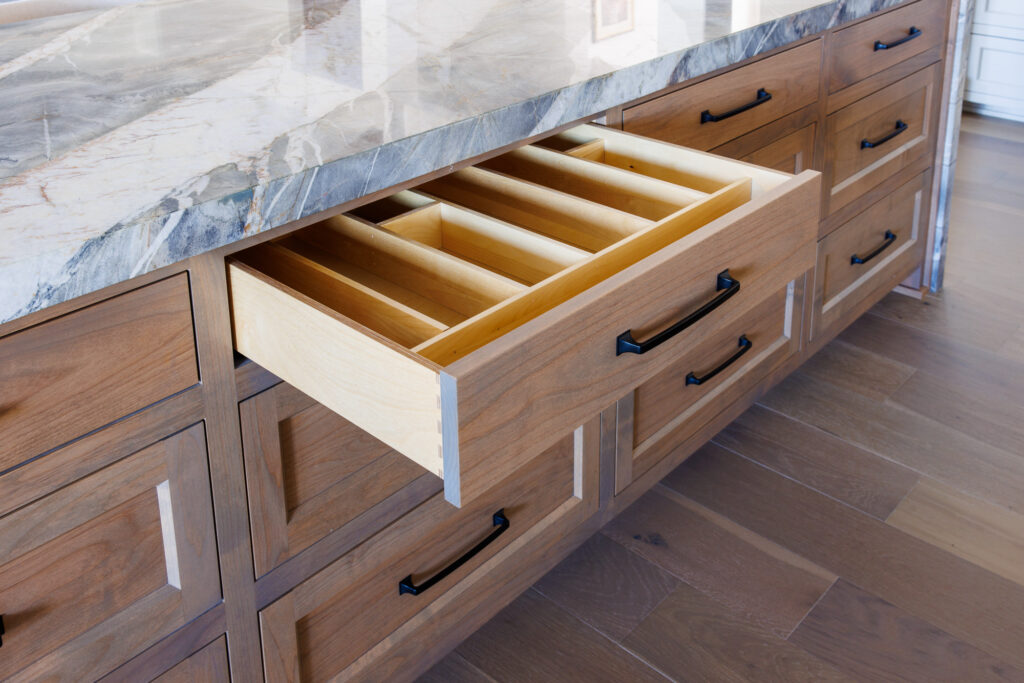
Custom cabinet drawer with a built-in utensil divider under a stone countertop
Which One Is Right for Your Home?
If your kitchen has a straightforward layout and you need an affordable update soon, stock cabinets can be a practical choice. If the room has unique dimensions, awkward spaces, or specific design requirements, custom cabinets can provide a more precise fit and a long-lasting solution.
When it comes to custom cabinets vs. stock cabinets, the right choice depends on your home, budget, kitchen layout, and how long you plan to stay in the home. Oak Ridge Cabinets builds custom cabinetry for homeowners in Chico and the surrounding area, with finished kitchens, bathrooms, and built-ins available to view in our project gallery. If you’re replacing countertops at the same time, our sister company Oak Ridge Countertops handles countertop fabrication and installation from the same Chico showroom, so both can be planned together.
Ready to see what custom cabinets would look like in your kitchen?
Tell us a bit about your space and what you want from it. We’ll measure, design, and give you a clear quote.
Schedule Your Free Consultation →
Frequently Asked Questions
What is the main difference between custom cabinets and stock cabinets?
Stock cabinets are made in standard sizes and sold from inventory. Custom cabinets are designed and built to fit one specific room, with your choice of materials, finish, and storage features.
Are custom cabinets worth the extra cost?
For homeowners who plan to stay put, have an irregular layout, or want more usable storage, custom cabinets usually pay off through a better fit and a longer service life. For a quick update or a rental, stock cabinets are often enough.
How long do custom cabinets take compared to stock cabinets?
Stock cabinets are often available right away or within a couple of weeks. Custom cabinets typically take several weeks because each one is designed, approved, and built to order.
Can stock cabinets work in an older Chico home?
They can, but older homes often have walls and floors that aren’t square, so installers rely on filler strips and shims. That can cost you storage space and leave visible gaps.
Are semi-custom cabinets a good compromise?
Semi-custom cabinets give you more size and finish options than stock at a lower price than fully custom. They work well when the layout is mostly standard but you want a few adjustments.
Do custom cabinets add value to a home?
Cabinets that fit the room and hold up well are one of the first things buyers notice in a kitchen. Custom cabinetry doesn’t guarantee a set return, but it can help a home stand out when it’s time to sell.
Does Oak Ridge Cabinets build for homes outside Chico?
Yes. Our cabinets are built in-house for homes throughout Butte County and beyond, and we’ve completed projects in Yuba City and Truckee. Contact our team to check whether we cover your area.
